Nuremberg 2025: A Modern Retelling of History’s Darkest Chapter
2025 will be the year when the world is introduced to an impactful and very timely movie adaptation of one of the most notable and somber events in the entire history - The Nuremberg Trials. Directed by an internationally renowned director Anna Richter, Nuremberg 2025 presents a somewhat perspective re-imagining of the war crimes tribunals that occurred after World War II. Mixing the elements of the documentary accuracy of history, deeply intense performances, and employing the latest technology in filmmaking, the film aims at not only looking back at the past but also, at posing tough questions on today's justice, accountability, and human rights standards.
This film takes off from the period of the post-war tribunals at Nuremberg where the top Nazi officials were marking their accountability for their involvement in the Holocaust. Nuremberg 2025, however, era-mixes by adding a sort of fictional future twist: the event is currently being revisited in 2025 through a worldwide inquiry of historical documents and evidence which have very recently come to light; accordingly raising the question of whether the cases to those who were able to escape being punished can be reopened. The picture depicts the quest for justice and the struggles of a radical group of people - advocates, journalists, historians, and survivors - against the politics and society that are, in various ways, turning away from history.
One of the protagonists of the film is Lucas Berg's character, a young prosecutor, full of guts and drive, who risks his career and even life when he reveals information that would shock the public about the Nazi collaborators continuing in the comfort of the secret unjust chambers, assimilating to the current political establishment. The prosecutor not only, figuratively, skirmishes with these difficult opponents but also with a world which does not want to remember and offers an attitude of indifference and resistance. The movie Nuremberg 2025 brings about the question of the present-day effects of power that is not regulated winning over silence and distortion of history. It tells about the emotional and ethical issues of this fight for culpable recognition which made arguably the greatest crime in history.
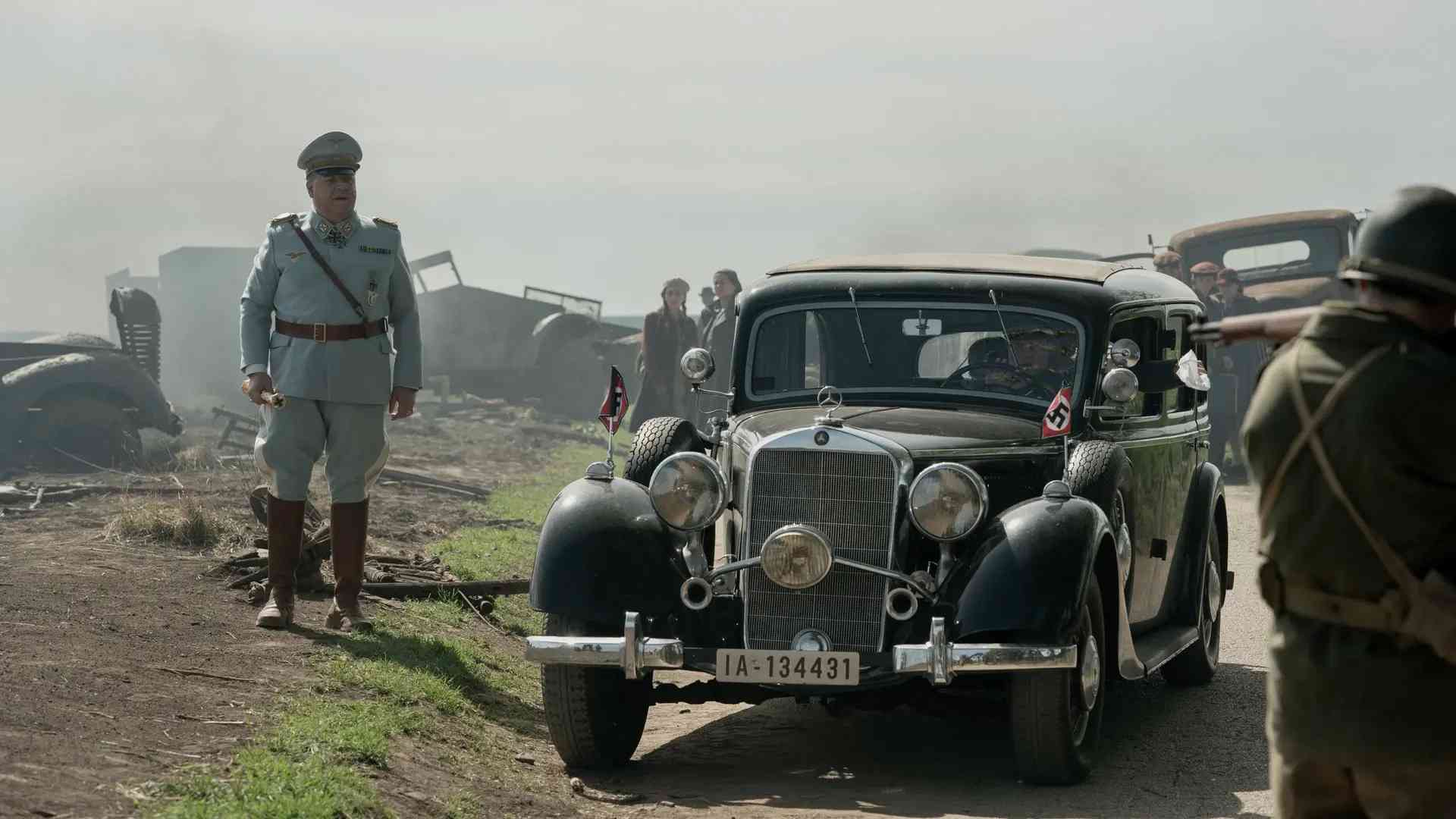
The visual treatment is among the things that make Nuremberg 2025 truly remarkable. The story is a tale of contrasts, and these contrasts are reflected in its visuals. Historical photographs from the original Nuremberg Trials can be seen alongside modern-day images, and this blending of the past and the present is also manifested through the use of archival footage and the latest high-definition technology. The scenes in the court are intense, raw, and poignant they convey the gravity of the trials through the prism of the contemporary world.
The color scheme of the motion picture is restrained and mainly uses the darker regions of the spectrum and play of lights and shadows to symbolize the courtroom atmosphere and to evoke feelings of a menace and a call for attention to the ongoing-injustice aspect. The visual translates the narrative's exploration of history as a continuous presence that always finds new ways of showing itself through current events and of how people repeatedly deny or even glorify the history of their culture.
The score is of great significance in amplifying the affective power of her work. The musician is responsible for the musical backdrop of Nuremberg 2025, gone from a very minimal, silent-factor pattern, to the full ultrabass one that reflects the weight of the drama. Sometimes music is very low-key and melancholic, but at other times it highlights the feeling of tension for very personal and human reasons behind the characters' faces, deepening the feeling already created by the scenes. The music is a great match to the story being played out in the courts and the gripping scenes where the protagonist uncovers the unmentionable and has to struggle not only with their source of power but also reconciling his or her quest for political stability with the justice of blood.
The actors in Nuremberg 2025 give absolutely outstanding interpretations. For example, Lucas Berg brings to life in a highly believable way a young prosecutor struggling to reconcile his firm belief in the law with the harsh reality that the law itself is often the biggest hurdle in his quest for justice. Also, the story comes alive thanks to the masterful performance of Eva Müller, a survivor of Auschwitz, who through the lens of her character helps the audience to comprehend the weight of the trials and their impact on the survivors and their relatives. Her portrayal is authentic and deeply touching, by which she gives not only a tragic but also a very human perspective that has left a deep impression on survivors even today.
Moreover, the cast is further enhanced by the presence of Thomas Richter as a pathologist who is accused of war crimes and defended by a lawyer who is willing to do whatever it takes. Being central to the theme of moral ambiguity, he utters words and makes characters that show the ambiguity of the law as well as the giving and taking of the right to live. At the heart of the film lies a very simple but powerful message in which the main characters' only way of coping with their own painful past is identifying and naming the root causes of that situation in order to be able to change the world they live in.
It challenges the audience to think about modern-day political corruption, human rights violations, and the continuation of certain ideologies that aim at cutting people off their history or distorting it. Although its story is based on the real Nuremberg Trials, the movie is a reminder to us nowadays of the increasing global threats of nationalism, fascism, hate speech, and political extremism and of the need to hold fast to the lessons we have learned from our collective past.
To summarize, Nuremberg 2025 is a powerful and moving drama that brings to light some of the darkest aspects of history in a way that resonates with today's audience. Through gripping performances, eye-catching shooting, and a very relevant message, the film reaches the very top of the director's craft and hence will become a classic. In a time when our society has to face such issues as fairness, responsibility, and remembrance, the movie acts as a very valuable memory aid in the sense that it reminds us not only that justice is always to be pursued but also that the learning never stops in the chain of history.